
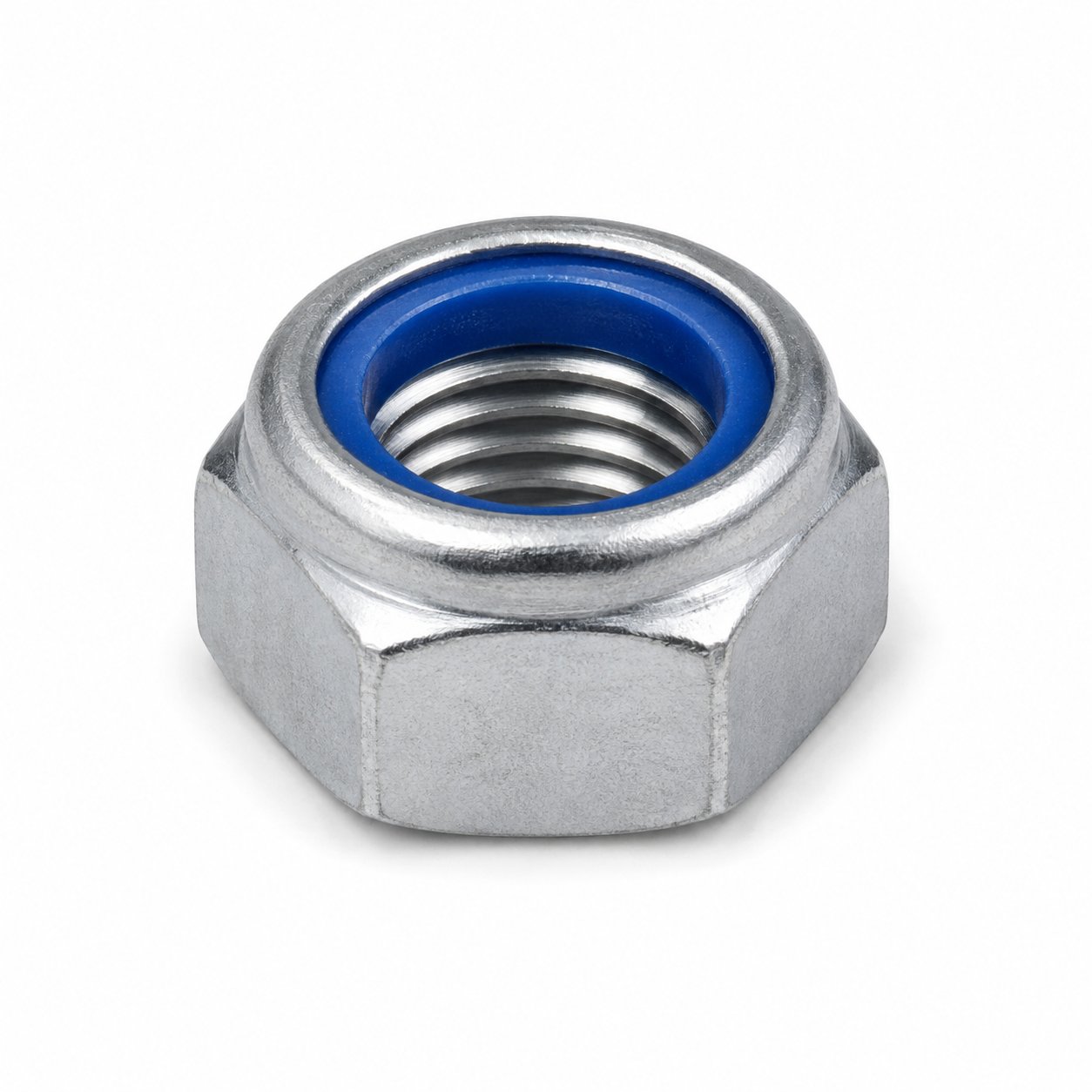
How the non-metallic insert works
DIN 985 is a thin-type hexagon lock nut with a non-metallic insert. As the insert engages the mating thread, it creates rotational resistance that helps limit unintended nut loosening.
This prevailing torque action does not guarantee retention of joint preload under every operating condition. This range covers the thin type with an insert; it does not include high-type or all-metal lock nuts.
Nut body, insert and property classes
Body: steel, stainless steel A2 or A4. Steel property designations in this overview: 8 and 10. Each size and its mechanical properties must be assessed against the specific product documentation, particularly for small diameters.
Locking element: a non-metallic insert. Its precise composition is checked for the supplied product; the body material designation does not determine the insert material.
A catalogue designation with additional marks must not automatically be treated as the same number without those marks. The original marking, technical documentation and joint design determine suitability for the application.
Surface finishes
The main documented finish for steel configurations is zinc plating. Specific items also have zinc flake coatings, such as M6 with steel designation 10 and zinc flake coating, or M8 with designation 8 and black zinc flake coating.
Finish, body material and property designation are specified separately. These coating examples do not imply availability of every combination or transfer the finish range of conventional hexagon nuts to this group.
Sizes and thread variants
The lists describe the catalogue range, not the dimensional scope of a technical standard. Compliance of the specific configuration is established by its product documentation. The listed property designations must be checked against the original marking and mechanical properties.
| Material | Steel property designation | Catalogue threads |
|---|---|---|
| Steel | 8 | M2; M2.5; M3; M4; M5; M6; M7; M8; M10; M12; M14; M16; M18; M20; M22; M24; M27; M30; M33; M36; M39; M42; M45; M48 |
| Steel | 10 | M4; M5; M6; M8; M10; M12; M14; M16; M18; M20; M22; M24; M27; M30; M33; M36; M39; M42; M48 |
| Stainless steel A2 | — | M2; M2.5; M3; M4; M5; M6; M8; M10; M12; M14; M16; M18; M20; M22; M24; M27; M30; M33; M36 |
| Stainless steel A4 | — | M2; M2.5; M3; M4; M5; M6; M8; M10; M12; M14; M16; M18; M20; M22; M24; M27; M30; M33; M36 |
The overview shows catalogue options, not current JENPEX stock. Availability depends on size, material, property class, thread and surface finish.
Fine metric threads
The full designation includes pitch. For example, M12 × 1.5 means a nominal diameter of 12 mm and a pitch of 1.5 mm; it is not the nut length. Finish is specified separately for the selected configuration.
| Material | Steel property designation | Catalogue threads |
|---|---|---|
| Steel | 8 | M8 × 1; M10 × 1; M10 × 1.25; M12 × 1; M12 × 1.25; M12 × 1.5; M14 × 1.5; M16 × 1.5; M18 × 1.5; M18 × 2; M20 × 1.5; M20 × 2; M22 × 1.5; M22 × 2; M24 × 1.5; M24 × 2; M27 × 1.5; M27 × 2; M30 × 1.5; M30 × 2; M33 × 1.5; M33 × 2; M36 × 2; M36 × 3; M39 × 3; M42 × 1.5; M42 × 3; M45 × 3; M48 × 3 |
| Steel | 10 | M8 × 1; M10 × 1; M10 × 1.25; M12 × 1; M12 × 1.25; M12 × 1.5; M14 × 1.5; M16 × 1.5; M18 × 1.5; M18 × 2; M20 × 1.5; M20 × 2; M22 × 1.5; M24 × 1.5; M24 × 2; M27 × 1.5; M27 × 2; M30 × 1.5; M30 × 2; M36 × 3 |
The overview shows catalogue options, not current JENPEX stock. Availability depends on size, material, property class, thread and surface finish.
This overview does not offer left-hand variants. Send a specific enquiry if you require one.
Applications, installation and limitations
Lock nuts are used in assemblies, machinery, servicing and maintenance where the joint design calls for resistance to nut rotation.
- Assess temperature and chemical compatibility against the insert as well as the steel or stainless steel body.
- Check temperature limits and chemical resistance in the documentation for the supplied configuration.
- Reuse must be permitted by the manufacturer and application requirements. The number of assembly cycles is not unlimited.
- Rotational resistance from the insert is distinct from the tightening required to generate joint preload. The installation procedure must account for both.
Matching the nominal M size alone is insufficient. Check pitch, thread direction, property and material configuration, finish and service conditions. Compatibility must follow the specific product documentation and joint design.
Related products
Related products are not an automatic recommendation for every combination of material, property class and thread.
Looking for a specific DIN 985 lock nut size?
Send us the required thread size, material or property class, surface finish and quantity. For fine or left-hand threads, include the full designation. We will check availability of the required configuration.
Request a quote →